Title Slide 1: The Effect of Sunspot Cycles on Human Health
Hello
It’s great to be here, meeting all my teachers and many of the students I’ve been with since I started this astrology journey.
Being able to combine medicine with astrology has been a gift. I love coming at subjects like the one I’m presenting now, MECHANISTICALLY, and once I get that, the maxim that Astrology represents “ALL THAT IS” is free to kick in for me.
So, with that, I’d like to share what I’ve learned about the Sun, its cycles, and the impact on health as part of my independent research project here with Kepler College.
Slide 2 – Captcha
Here is a captcha that has all the references and ntoes

Slide 3 – Introduction
The Sun “represents the energy that enables everything else to exist. It is the basic energy of Being. Just as the physical Sun shines and enables all the other bodies to shine by reflecting its light, so the symbolic astrological Sun is the basic energy of which all the other planetary energies are specialized reflections.”
“The energy that exerts itself upon and influences whatever may exist. The energy of the Sun does not simply accept, but always seeks to change, and if possible, improve. Above all, it seeks room for greater expressions of itself… attempts to bring order out of chaos…He will undergo severe trials in order to prove his strength and worthiness…”
As physical energy, can be weakened by contact with draining aspects — connection with Neptune, Aquarius or Libra. Boosted energy with Mars aspects.
Source: Hand, Robert. Horoscope Symbols. 1st ed. Schiffer Publishing, Limited, 1997.
The Sun “represents the energy that enables everything else to exist. It is the basic energy of Being. Just as the physical Sun shines and enables all the other bodies to shine by reflecting its light, so the symbolic astrological Sun is the basic energy of which all the other planetary energies are specialized reflections.”- I’d like to highlight that phenomenon exists as a reflection of the Sun in this quote by Robert Hand and return to this idea later.
The Sun is “The energy that exerts itself upon and influences whatever may exist. The energy of the Sun does not simply accept, but always seeks to change, and if possible, improve. Above all, it seeks room for greater expressions of itself… attempts to bring order out of chaos…[The Sun] will undergo severe trials in order to prove his strength and worthiness…” – so the Sun deals with challenges and creates order.
As physical energy, the Sun can be weakened by contact with draining aspects such as connection with Neptune, or being in the sign of Aquarius or Libra. Likewise certain aspects, such as with Mars, can boost the Sun’s energy. – As a phenomenon, though, these draining or boosting effects are reflections of what the Sun is producing. The Sun is the primary energy; it spreads its light to the other planets, and THEY reflect back! The Sun is the hero in this … it ventures out and gathers the energy and creates order out of chaos.
As astrologers, we are aware of the Sun’s key words – in the positive: Light, consciousness, day. Yang energy, will to exist, power, desire, “wanting to”. The vital force, the “I”, the “nucleus” of the atom and the cell. The physical body, the heart, the spine. Initiative. Independence. In the negative: Boastful, arrogant, wrapped up in itself. Overestimation of self-worth. Difficulty working in cooperation with others.
Slide 4 – The mechanism

ATOM
ELEMENT
MOLECULE
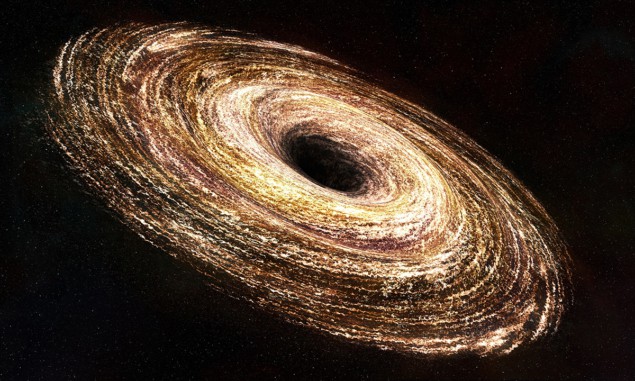
Spin transfer Artist’s impression of an accretion disc surrounding a black hole. (Courtesy: Shutterstock/oorka)
Author, No. “Liquid-Metal Experiment Simulates Astrophysical Accretion Discs.” Physics World, August 30, 2022. https://physicsworld.com/a/liquid-metal-experiment-simulates-astrophysical-accretion-discs/.
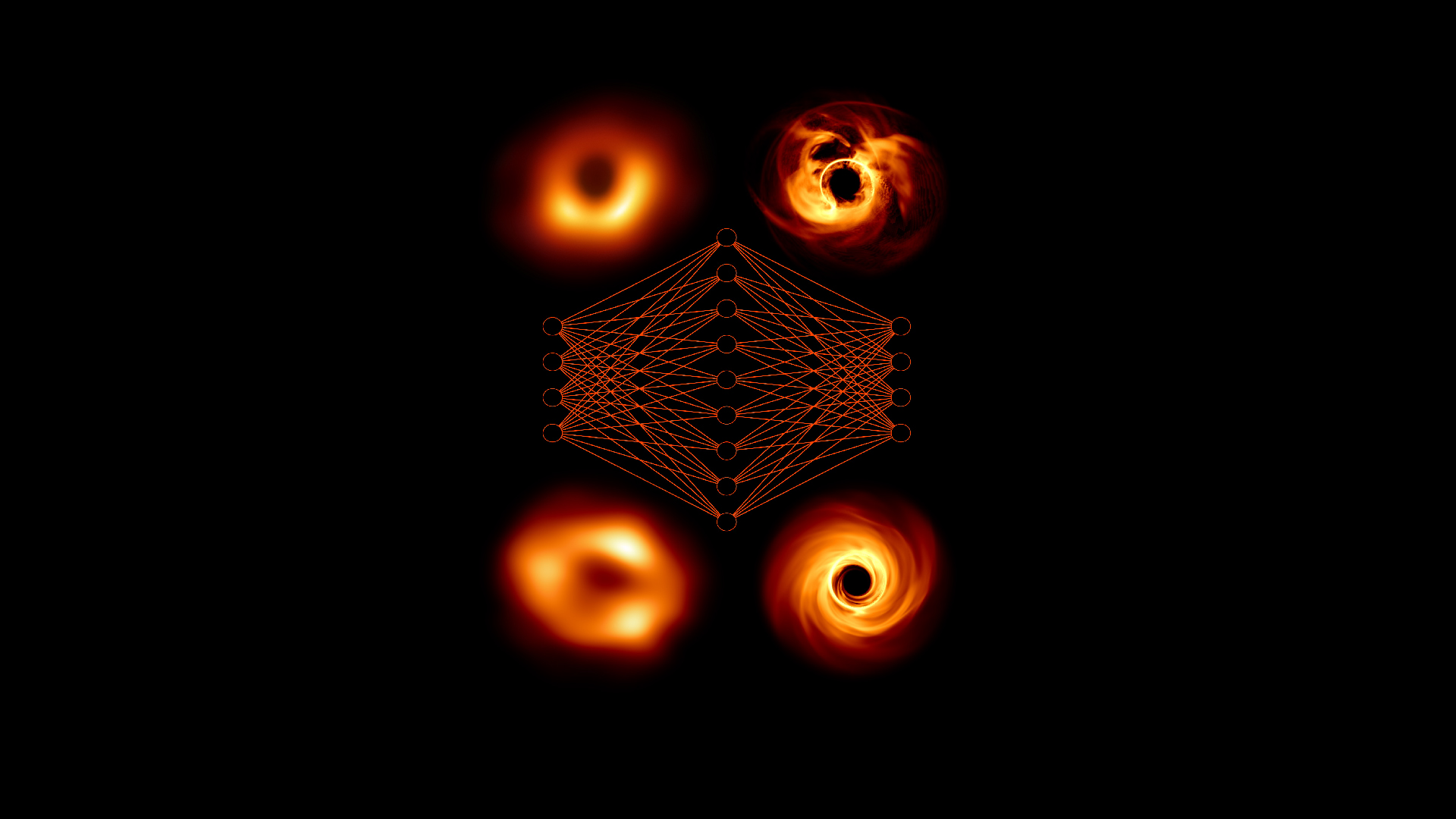
A new AI model (right) has helped flesh out details in the first-ever images of black holes (left) taken by the Event Horizon Telescope. But can the new models be trusted? (Image credit: EHT Collaboration/Janssen et al.)
published, Joanna Thompson. “‘Artificial Intelligence Is Not a Miracle Cure’: Nobel Laureate Raises Questions about AI-Generated Image of Black Hole Spinning at the Heart of Our Galaxy.” Live Science, June 17, 2025. https://www.livescience.com/space/black-holes/artificial-intelligence-is-not-a-miracle-cure-nobel-laureate-raises-questions-about-ai-generated-image-of-black-hole-spinning-at-the-heart-of-our-galaxy.
With that, I would like to share my understanding of these quotes more mechanically.
The mechanics seem to start with the spinning Sun that exists in a field of moving particles that perhaps used to be called ether, now known as photons (or light particles).
The photons that make up this field that is all around us are actual physical objects – they have mass and density.
The photons move at variable speeds – so they have velocity. When photons strike other objects they have real effects.
The photons also hit each other and each gets knocked into a spin, in the direction a clock moves or the other way – there are 2 spins that give what we call polarity.
So there are spinning fields of photons … light….
When light meets a spinning ball, the clockwise-spinning photons go in one side and the counterclockwise spinning photons to the other side, and then they mix in the center of the ball, and get ejected from the equator or the middle of the ball.
This is simply diagrammed here… you can see in the images that the atom, the elements, and the molecules all contain a nucleus and poles through which photons enter
SLide 5 – Charge Recycling

Here are images of the Sun, the Earth, the other planets and the Galactic Center all demonstrating this basic mechanism.
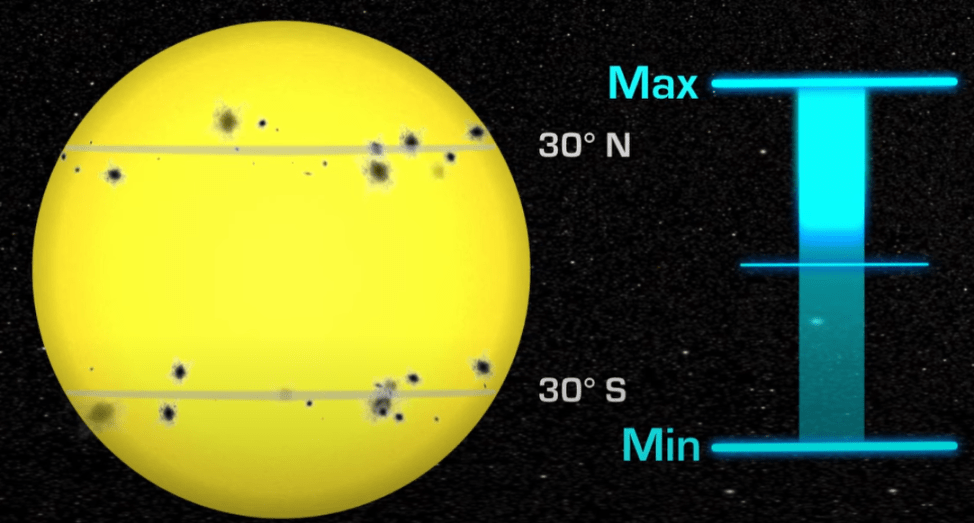
From these NASA photos and diagrams we see the ejection of the photons from the Sun at the 30 degree marks of the equator. Similarly we see heat released from the Earth at these 30 degree marks where the photons are released. The magnetic field of the Sun (a product on the photon field release) is depicted here, which connects the entire solar system together as the Heliosphere. Interesting that the Heliosphere emerges from the Sun in an Archemedes spiral – please see David Cochranes Vibration astrology You Tubes on the creation of the Zodiac from real structures in space dervied from the pricnapals of the Golden Mean or Archimedes spiral. Very interesting that each spinning ball or planet may create real structures consistent with a Zodiac.
SLIDE 6 – Solar System and Galactic Mechanics

By Jim slater307 – Own work, CC BY-SA 4.0, https://commons.wikimedia.org/w/index.php?curid=60999524
We can see in this diagram a depiction on the Sun circling the galactic center. Using these basic principals, we may deduce with some confidence that the Sun receives charge from the larger galaxy, probably the galactic center which is often called a black hold but may actually be creating photon or charge flow. Upon reaching the Sun, the charge goes in through the poles and out the equator at 30 degrees N and S.
The Charge emission make up the Solar Wind and the Heliopsphere that connects all the elements in the Solar System. The planets including the Earth receive the charge through the poles and discharge the energy through the 30 degree N and S mark – these are the meridians of the Earth. The Larger Planets send considerable charge back out. It is this charge recycling that interacts with the Sun that creates the Solar Cycles as we will see.
Aspects to the Jovian planets such as conjunctions lead to solar maxima and squares to minimums.
A Jovian lining up with the galactic center adds considerable charge to the Sun.
The Earth is recycling charge and charge peaks in the infrared (infrared is longwave). Every particle and body in the universe—from the electron to the galaxy—is a charge reactor. It is a machine that recycles waste. A spinning sphere in a charge field immediately and naturally sets up charge potentials, and if that sphere is porous to charge, the charge comes in the poles and is emitted at the equator. The Earth does this just like the proton does and the Sun does and the galaxy does. The spinning ball is the grand engine.
The poles are cold because planetary heat isn’t caused by dynamos or residual heat from formation; it is caused by charge recycling. And due to the form of charge recycling by spinning spheres, charge must go in at the poles and out at the equator. Due to photon spin mechanics, charge coming in causes cooling while charge going out causing heating. Thus we see ice caps on Mercury (https://milesmathis.com/mercice.pdf)
Slide 7 – Axial Tilt
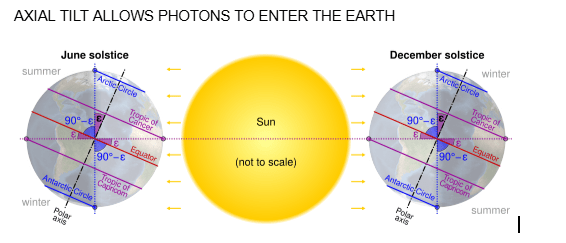
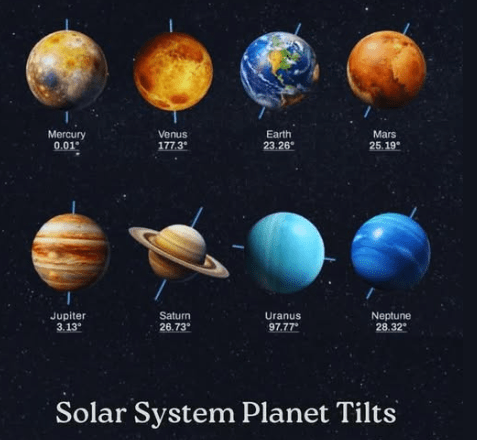
This theory has a mechanism capable of explaining the temperature difference seen in the seasons. And this means that although the seasons are caused in part by tilt, as we are taught, all the variations north and south are NOT caused by tilt or Sun angle. Climate variations are a sum of Solar radiation and charge recycling, with charge recycling being a very major player. How major? Conservatively, about 44% of the Earth’s total heat is due to charge recycling.
So we can see in the diagram when the north pole is facing towards and receving charge from the Sun we have summer conditions. The south pole facing sun leads to winter (in the North). At the equinoxes there poles are equal to the Sun. But in all cases the Earth is also receving charge from the outer planets.
Each planet has its own axial tilt situation as it is receiving charge from the Sun as well as other large planets, its angle of tilt reflect the planets surrounding it.
Key Takeaways from the diagram…
Uranus is the most tilted, essentially rolling on its side – it is surrounded by large charge fields in both directions
Venus spins nearly upside-down, possibly due to a massive collision in its past.
Mercury and Jupiter are barely tilted, so they lack distinct seasons. Jupiter at 3.1° has almost no seasons, as it is nearly upright due to charge from outer planets and Sun
Earth, Mars, Saturn, and Neptune have noticeable tilts and experience significant seasonal variations.
Slide 8 Humans Emit Photons Also
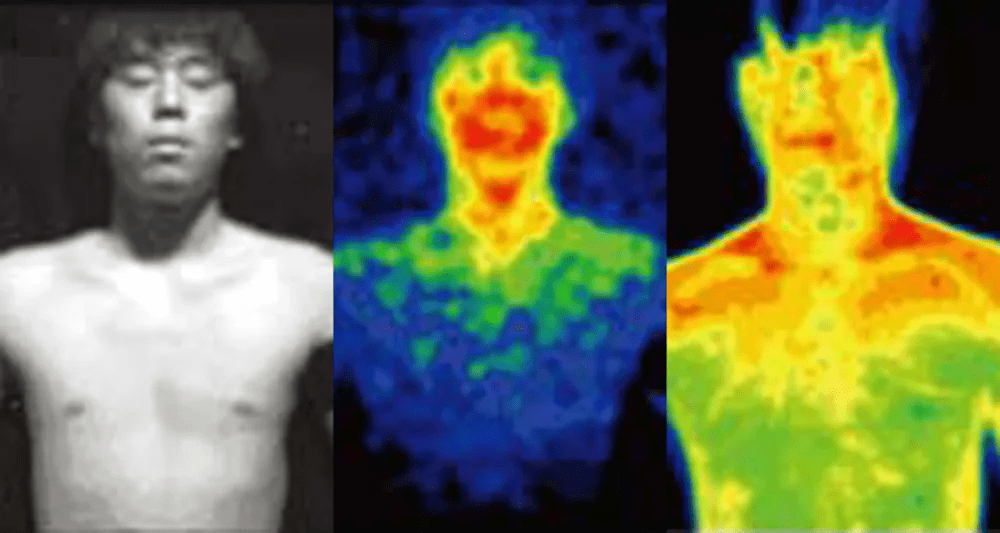
This first image shows one of the test subjects in full light. Throughout the day, the body gives off weak emissions of visible light in totally dark conditions, as the color-coded middle image shows. The rightmost image of the subject, captured in infrared wavelengths, shows the heat emissions.Kyoto University/TIT
In the human, there is what seems to be a spinning aura and the energy flow in the body is spinning and recycling charge… The human body literally glows, emitting a visible light in extremely small quantities at levels that rise and fall with the day, scientists reveal.
The researchers found the body glow rose and fell over the day, with its lowest point at 10 a.m. and its peak at 4 p.m., dropping gradually after that. These findings suggest there is light emission linked to our body clocks, most likely due to how our metabolic rhythms fluctuate over the course of the day.
Since this faint light is linked with the body’s metabolism, this finding suggests cameras that can spot the weak emissions could help spot medical conditions
NBC News. “Humans Glow in Visible Light.” July 22, 2009. https://www.nbcnews.com/id/wbna32090918.
This is a basic description of the mechanism which will guide this talk. It is quite different from gravity as when the photons are ejected they bombard objects they meet with a real force and so REPEL other objects. Whereas, gravity we know ATTRACTS. So we actually have 2 forces with spinning ball that act as a counterbalance and make the UNIVERSE capable of dealing with challenges or stress, or novelty – in astronomy these are called PERTURBATIONS. The Universe seeks novelty I am convincced, and we are here in some sense to be novel and express our own unique individual natures, and this mechanism as presently understood provides that ability.
SLide 7 – Agenda
We are here to discuss the Sun Cycle and Human Health, so focusing on the Sun’s interaction with the Earth, we see that this interaction is quite complex.
The Sun impacts the Earth’s weather, the Earth’s crust causing earthquakes and volcanoes, Earth’s animals and their migration patterns, and humans through mass emotional or physical movements, as well as their health.
We are going to look specifically at health, and to do that, I am going to look at an astrology chart, in this case, the actor John Ritter, whose experience will guide us through a discussion of the Sun’s impact on the Earth.
First we will look at the Sun’s Sudden Impact effects on the Earth, then the Circadian or Day-to-Day effects, followed by Seasonal and then Solar Cycle or Sunspot cycle effects.
Slide 10- The Sun
Image 1
By Kelvinsong – Own work, CC BY-SA 3.0, https://commons.wikimedia.org/w/index.php?curid=23371669
Image 2
By CactiStaccingCrane – Own work, CC BY-SA 4.0, https://commons.wikimedia.org/w/index.php?curid=117066753
Notes:
The Sun is an average-sized Yellow dwarf star at the center of the Solar System, and orbits the Milky Way Galaxy at a distance of about 25,000 light-years from the center, called SagA, at a speed of 200km/s
There are an estimated 100 billion galaxies in the known universe. The Sun and its eight planets, including Earth, reside in one known as the Milky Way. Our galaxy is around one quintillion or 100,000 light years.
The Sun is in a spiral arm of the Milky Way called the Orion Spur. This branches off from the galaxy’s Sagittarius arm. The Sun and our solar system are orbiting around the of the Milky Way at a speed of 720,000 per hour. It takes 230 million years to make one complete orbit.

By Image courtesy of NASA / JPL-Caltech / R. HurtOriginal text courtesy of NASA / JPL-CaltechSVG conversion by Holek – SVG version of Image:Oort cloud Sedna orbit.jpg, which lists the following sources: [1] [2] Splitzer Space Telescope Released Images about Sedna, Public Domain, https://commons.wikimedia.org/w/index.php?curid=1076927

By File:Artist’s impression of the Milky Way.jpg: NASA/JPL-Caltech/ESO/R. Hurtderivative work: Cmglee – File:Artist’s impression of the Milky Way.jpg, Public Domain, https://commons.wikimedia.org/w/index.php?curid=14646767
By Jim slater307 – Own work, CC BY-SA 4.0, https://commons.wikimedia.org/w/index.php?curid=60999524

By raster by Cliff12345 (taken from NASA)vectorization by B. Jankuloski – File:The Local Interstellar Cloud and neighboring G-cloud complex.gif, CC0, https://commons.wikimedia.org/w/index.php?curid=124489230
Its distance from Earth is about 8 light-minutes.
The Sun’s mass is about 330,000 times that of Earth and makes up about 99% of the total mass of the Solar System.
It is a massive, nearly perfect sphere of hot plasma, heated to incandescence by nuclear fusion reactions
The core is the hottest part of the Sun is 15 million degrees Celsius.
In the Sun’s atmosphere, known as the corona, the temperature is roughly two million degrees Celsius.
The mass of outer layer of the Sun’s atmosphere, its photosphere, consists mostly of 3/4 hydrogen (~73%) and 1/4 helium (~25%)
The Sun radiates or releases photons as well as charged particles from its surface in the form of SOLAR WIND. The wavelengths of the photons produce light and include visible light and infrared radiation, with 10% at ultraviolet energies.
Sources:
-
-
- “The Sun | Natural History Museum.” Accessed August 29, 2025. https://www.nhm.ac.uk/discover/factfile-the-sun.html.
- Wikipedia. “Sun.” August 25, 2025. https://en.wikipedia.org/w/index.php?title=Sun&oldid=1307754006.
-
Slide 11- Sunspots
Image
NASA Goddard, dir. NASA | Solar Cycle. 2011. 03:26. https://www.youtube.com/watch?v=sASbVkK-p0w.
Notes:
Sunspots are cooler parts of the Sun’s surface and occur in the photosphere and appear darker to us than the warmer plasma surrounding it.
These cooler spots can be up to 50,000 kilometres across. They are thought to be caused by interactions with particularly strong regions of the underlying magnetic field.
Sudden Effects
Solar flares are the largest explosive events in the entire solar system. They occur when the magnetic fields associated with the sunspots convert energy into heat and accelerate particles, ejecting them into space.
They are by a burst of photons – or light – at almost every wavelength and can last from just a couple of minutes to a few hours.
Slide 12 – What is the Solar Cycle?
Image:
CC BY-SA 3.0, https://commons.wikimedia.org/w/index.php?curid=969067
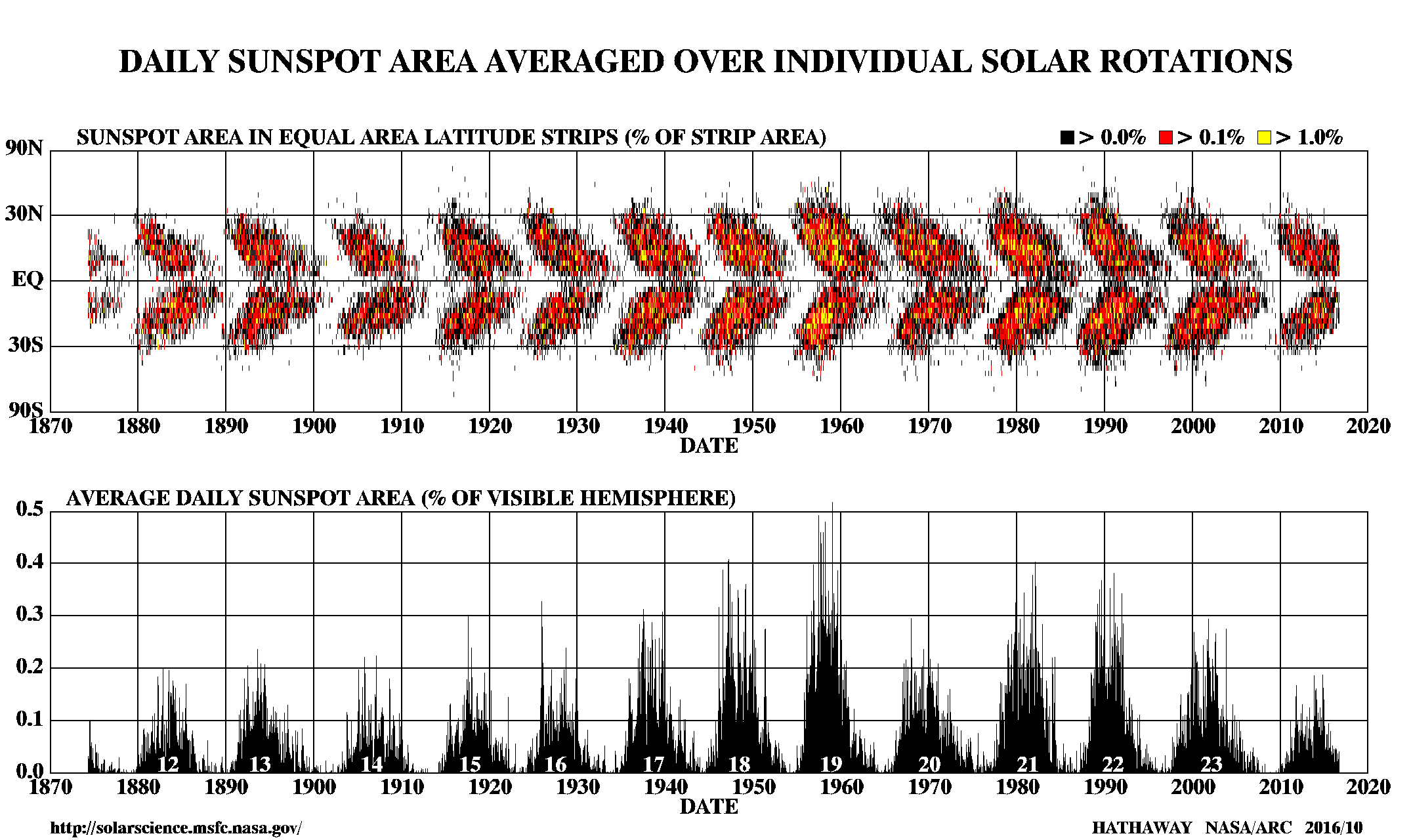
The solar magnetic activity cycle, sunspot cycle, or Schwabe cycle, is a periodic 11-year change in the Sun’s activity measured in terms of variations in the number of observed sunspots on the Sun’s surface.
Over the period of a solar cycle, levels of :
-
- solar radiation
- ejection of solar material
- the number and size of sunspots
- solar flares
all exhibit a synchronized fluctuation from a period of minimum activity to a period of maximum activity.
The magnetic field of the Sun flips during each solar cycle, with the flip occurring when the solar cycle is near its maximum. After two solar cycles, the Sun’s magnetic field returns to its original state, completing what is known as a Hale cycle.
This cycle has been observed for centuries by changes in the Sun’s appearance and by terrestrial phenomena.
Wikipedia. “Solar cycle.” July 7, 2025. https://en.wikipedia.org/w/index.php?title=Solar_cycle&oldid=1299206044.

By NASA, Marshal Space Flight Center, Solar Physics – http://solarscience.msfc.nasa.gov/images/bfly.gif (updated monthly)http://solarscience.msfc.nasa.gov/SunspotCycle.shtml (explanatory text), Public Domain, https://commons.wikimedia.org/w/index.php?curid=2543387
Updated Solar Cycle Data
SLIDE 13 – What causes the sunspot cycles?
Image:
Jose, Paul D. “Sun’s Motion and Sunspots.” The Astronomical Journal 70 (April 1965): 193. https://doi.org/10.1086/109714.
What causes the sunspot cycles?
This question has beguiled astronomers for 100s of years at least. In our age, the sun spots have been mapped for 400 years, and it has been noted that there is a cyclic recurrence of the pattern of sunspots. In this image, we see a very similar pattern repeating itself from 1610 onwards in periods of 179 years. This suggested to early researchers that there was an outside influence on the Sun. Jupiter has been the source of immense study in attempts to predict solar cycles based on the position of Jupiter relative to the Sun and other planets. For instance, it seems quite logical that since Jupiter’s orbital year is 11 and the sun cycle averages 11 years that there must be a relationship. But the research has been equivocal and controversial.
Dickinson, David, and Universe Today. “What Drives the Solar Cycle?” Accessed August 29, 2025. https://phys.org/news/2015-03-solar.html.
Slide 14 – Sun Rotates
Image:

Jose, Paul D. “Sun’s Motion and Sunspots.” The Astronomical Journal 70 (April 1965): 193. https://doi.org/10.1086/109714.
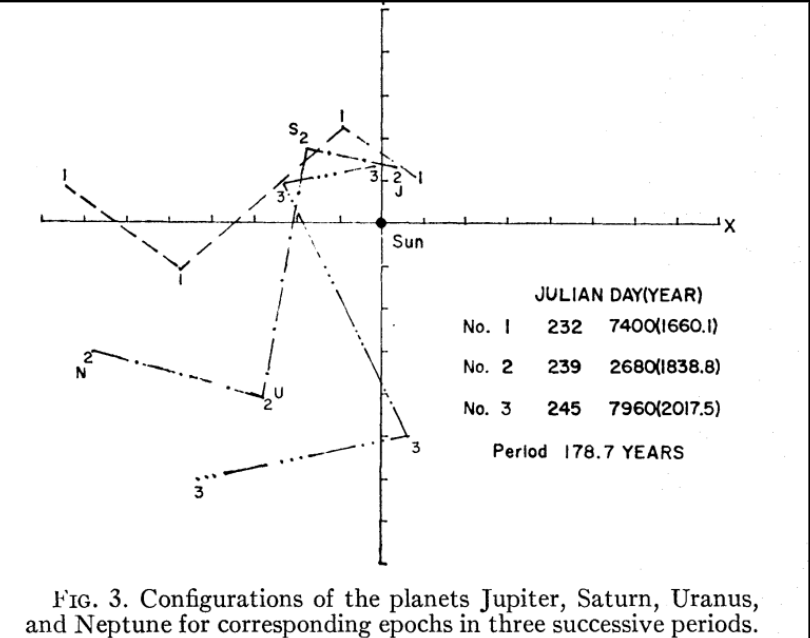
In the 1960s it was found that the centre of the Sun moves around the Solar System barycentre in a pattern of interlocking rings that repeats approximately every 179 years (nine times the synodic period of Jupiter and Saturn) and rotates about 24 degrees.
For some periods of several decades (when Neptune and Uranus are in opposition), the motion is rather regular, whereas between these periods it appears more chaotic.
The position of the outer planets in epochs of 179 years is associated with recurring patterns of sunspot activity. The 179 years seem to be a sub-cycle of a 350 and 2400-year cycle using modern methods of investigation.
“…the motions of the Earth and the Sun are primarily due to Jupiter and the other giant planets, which accelerate the Earth and the Sun in nearly the same direction, and thereby generate highly-correlated motions in the Earth and Sun.”
Researchers note that the total angular momentum of the solar system is constant, which implies there is a constant rotation of the solar system. This suggests that the Procession of the Equinox is not related to a gravity-induced wobble of the Earth, but instead related to the rotation of the solar system!
Zharkova, V. V., S. J. Shepherd, S. I. Zharkov, and E. Popova. “Retraction Note: Oscillations of the Baseline of Solar Magnetic Field and Solar Irradiance on a Millennial Timescale.” Scientific Reports 10 (March 2020): 4336. https://doi.org/10.1038/s41598-020-61020-3.


‘The relationships set forth here imply that certain dynamic forces exerted on the sun by the motions of the planets are the cause of the sunspot activity. This is supported by the 178+ year periods in the sun’s cycles.’
Jose, Paul D. “Sun’s Motion and Sunspots.” The Astronomical Journal 70 (April 1965): 193. https://doi.org/10.1086/109714.
The centre of the Sun moves around the Solar System barycentre, within a range from 0.1 to 2.2 solar radii. The Sun’s motion around the barycentre approximately repeats every 179 years, rotated by about 30° due primarily to the synodic period of Jupiter and Saturn.
By Solarsystembarycenter.gif: Carl Smithderivative work: Rubik-wuerfel (talk) – http://s173.photobucket.com/user/CarlSmith_2007/media/Sun%20SSB/ssb-orbit-col.gif.html > GIF, CC BY-SA 3.0, https://commons.wikimedia.org/w/index.php?curid=9952653
“The cycle was confirmed by Fairbridge and Shirley (1987) since 760 AD, and by Fairbridge and Sanders (1987) since 777 AD. Jakubcova and Pick (1987) verified the 178.7 year cycle as the basic period of solar motion periodicities.”
‘The discovery of the exceptional 370-year segments of solar motion that recur in steps of 2402 years and their imprint in the radiocarbon record”
‘The basic cycle of 178.7 years, being the interval between consecutive 50-year orbital trefoils, is twice shortened by about 20 (JS) years, and during the intermediate intervals the Sun moves along the trefoil to a quasitrefoil orbit (Fig. 4). The 50-year orbital trefoils in steps of 178.7 years and the 370-year exceptional segments in steps of 2402 years represent the exceptional patterns of solar motion’
Charvátová, I. “Can Origin of the 2400-Year Cycle of Solar Activity Be Caused by Solar Inertial Motion?” Annales Geophysicae 18, no. 4 (2000): 399–405. https://doi.org/10.1007/s00585-000-0399-x.
A study of the impact of Jupiter, Earth and Sun alignment showed that conjunctions related to Earthquakes.

Here is a chart froma study showing increased earthquakes on Earth related to aspects between the Sun-Earth-Jupiter. Jupiter is in RED, Earth is WHITE, Sun in CENTER. There is some additive influence of Jupiter and the Sun on the Earth.
Looking at this mechanically in the simplest way possibe, we are talking about a h electromagnetic pathways created by the sun’s discharge of light (or photons) known as the solar wind that creates a web of connectivity throughout the solar system (neutrinos).
The planets receive the light and some it gets recycled coming in through the poles and discharged at the equator back laong the pathrways back to the Sun.
So, when earth is between the Sun and Jupiter it is receiving a double dose of photons which overheats the Earths core and activates the mantle causing Earthquakes.
So, in our case, the combination of the Uranus op Jup to Sun created conditions that may have caused a CME release to Earth.
SOURCE
Source: By Jim slater307 – Own work, CC BY-SA 4.0, https://commons.wikimedia.org/w/index.php?curid=60999524
Slide 15 – Jupiter-Sun-Earth Alignments and Earthquakes
Image:
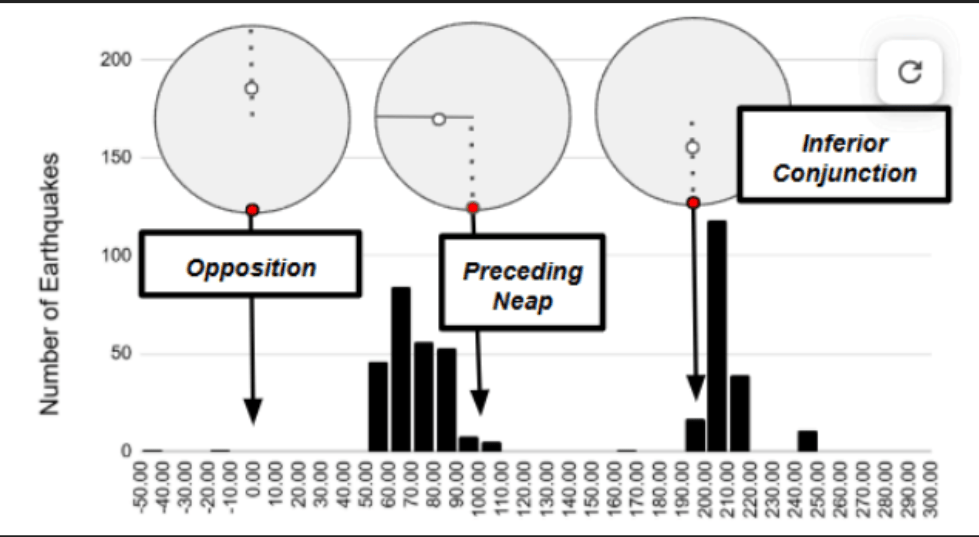
As a demonstration on a smaller scale, this research looks at the influence of Jupiter…based on aspects with the Earth and the Sun. When Jupiter is opposite the Sun, there are no Earthquakes reported on the Earth in this data. When on the same side of the Earth there are earthquakes seen, when square there are preceding quakes, when conjunct there are quakes following.
This suggests that the charge coming from Jupiter back to the Sun is consumed by the Earth, creating excess internal charge that expresses itself through the mantle of the Earth and results in pressure relief.
Slide 16 – John Ritter Case and Natal Chart
Image:
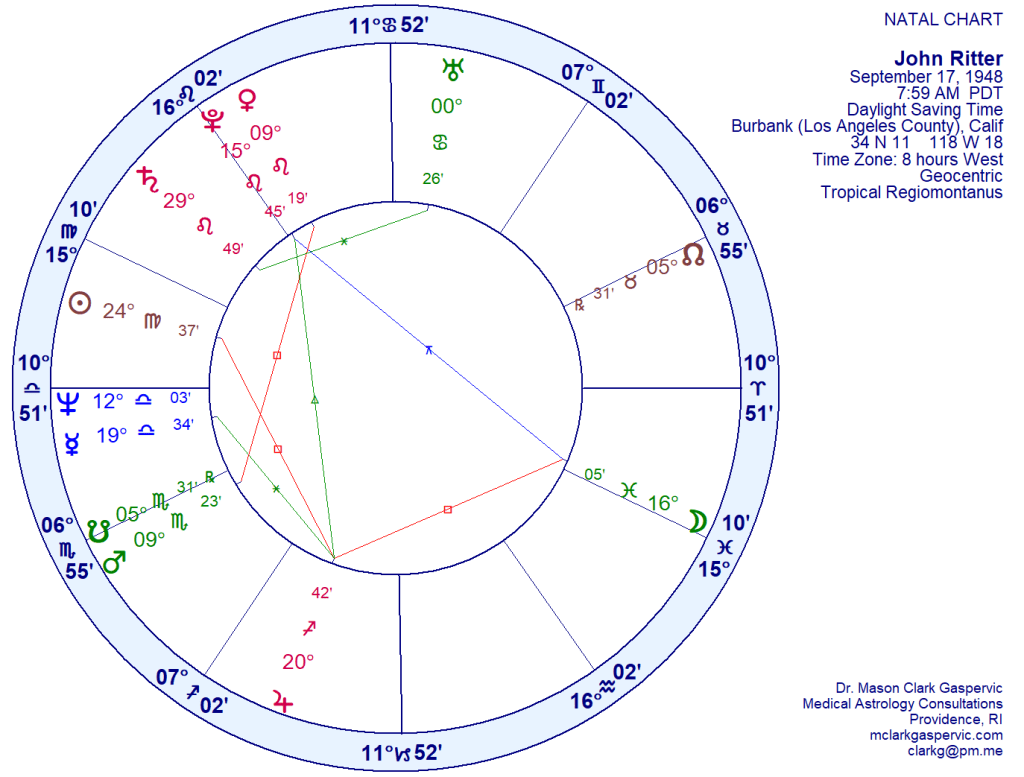
So, let’s look at a case to ground this discussion is an astrology chart. John Ritter was a well-known actor and the star of the successful TV show Three’s Company. On September 11, 2003, Ritter was rehearsing in Los Angeles, CA, when he suddenly fell ill: sweating profusely, vomiting, and complaining of chest pain with what was later found out to be an aortic dissection, which led to him have a cardiac arrest and being pronounced dead at 10:48 p.m.
Let’s look at his Natal chart with AA rating in a Regiomontanus house system.
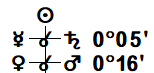
In the natal chart, I mainly want to point out that the Sun is at a near-exact midpoint between Mercury and Saturn. Saturn in Leo suggests predisposition to restrictions in the heart, whereas Mercury in Libra suggests problems with homeostasis – the Sun in Virgo, 12th House, suggests hidden problems related to digestion. Also I would like you to know HIS NATAL Temperament is CHoleric – Hot and Dry like the Sun.

Sources:
https://www.australiawidefirstaid.com.au/resources/cardiac-arrest-deaths#:~:text=Listed%20below%20are%2010%20well,James%20Stewart “John Ritter: 1948–2003”.
People. September 18, 2003. Archived from the original on November 22, 2016. Retrieved November 23, 2022.
Considine, Bob (February 4, 2008). “John Ritter’s widow talks about wrongful death suit”. Today. NBC. Archived from the original on December 5, 2014. Retrieved December 2, 2013.
Slide 17 – Birth in the Solar Cycle
Image:

He was born at the peak of a solar maximum, which suggests that the Sun was energized at his birth. And that the Sun was energized throughout his fetal development, and that preceding that, his parents were in a period of high sun activity. As we will see later, this is a double-edged sword – too much energy can be disruptive and should not be seen as only in a positive light.
Slide 18 – John Ritter Case and Transit Chart
Image
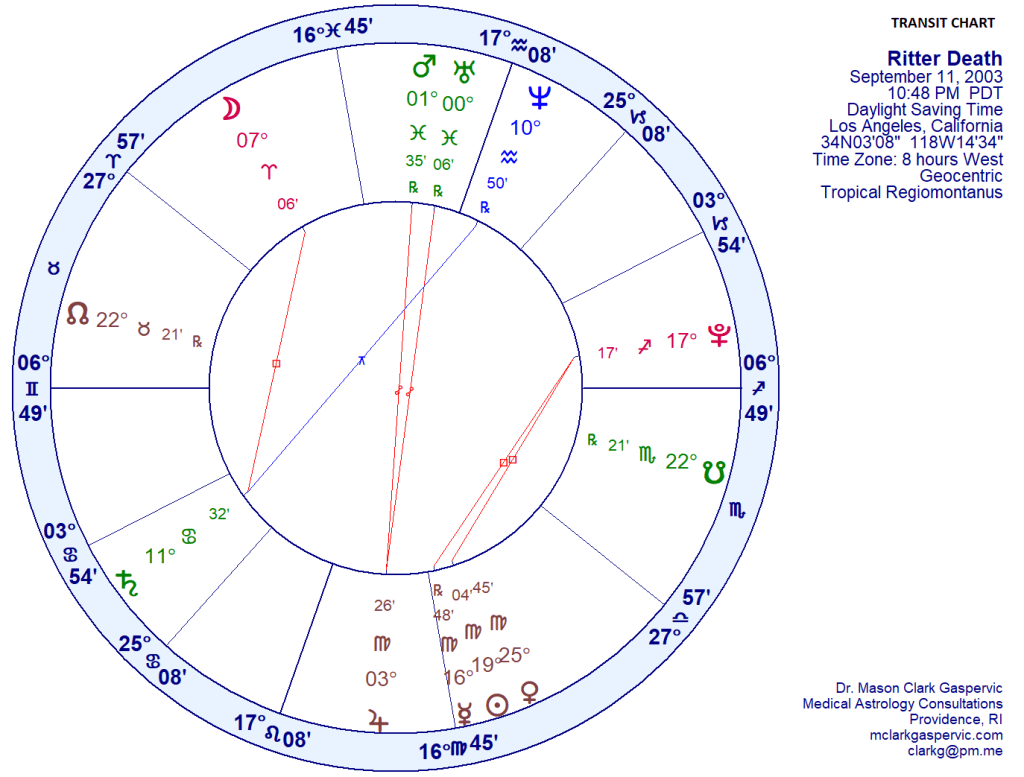
Looking at the Transit at the time of death …. We have the 6th House of disease in Libra (a CARDINAL SIGN suggesting acute disease) with the ominous presence of the South Node in the 6th House; Libra is ruled by Venus in conjunction with the Sun and Mercury in Virgo —- we are looking at possible overindulgence and intestinal inflammation connecting to the acute cardiac problem.
Take note that the END OF THE MATTER is the 4th House of Leo (the Heart), which has Jupiter in opposition to Uranus/Mars. Keep these in mind when we move to a heliocentric view…
In a Biwheel, interestingly, we see that Transit Sun and Mercury are triggering the Natal Sun (signifying Ritter’s Heart), which is at a near exact (6-minute) midpoint of Natal Saturn in Leo (restrictions in the Heart) and Mercury in the 1st House. For sure, this can lead us to conclude the Heart is at risk.
Slide 19 – The Solar Cycle at Death
Image:
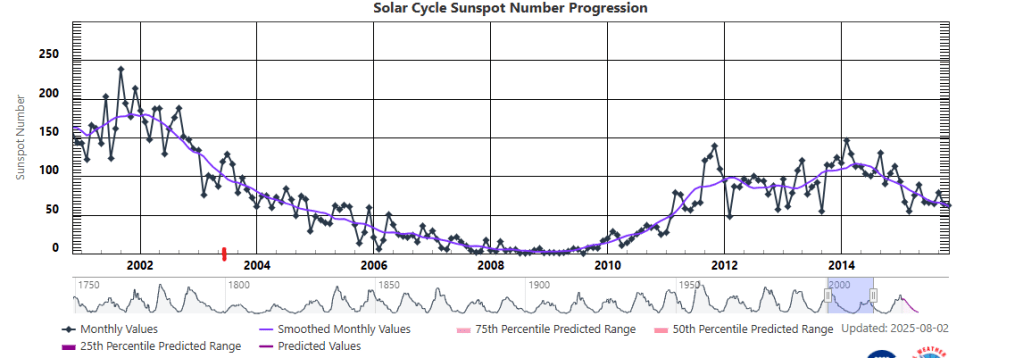
Although the death occurred on the downslope of a maximum, solar activity can still result in sudden effects, like a coronal mass ejection….
Slide 20 – CME and Death
Image:

And, as fate would have it, we did have a CME about 10 pm the night before his heart attack, over LA.
Slide 21 – CME and Heart Attacks
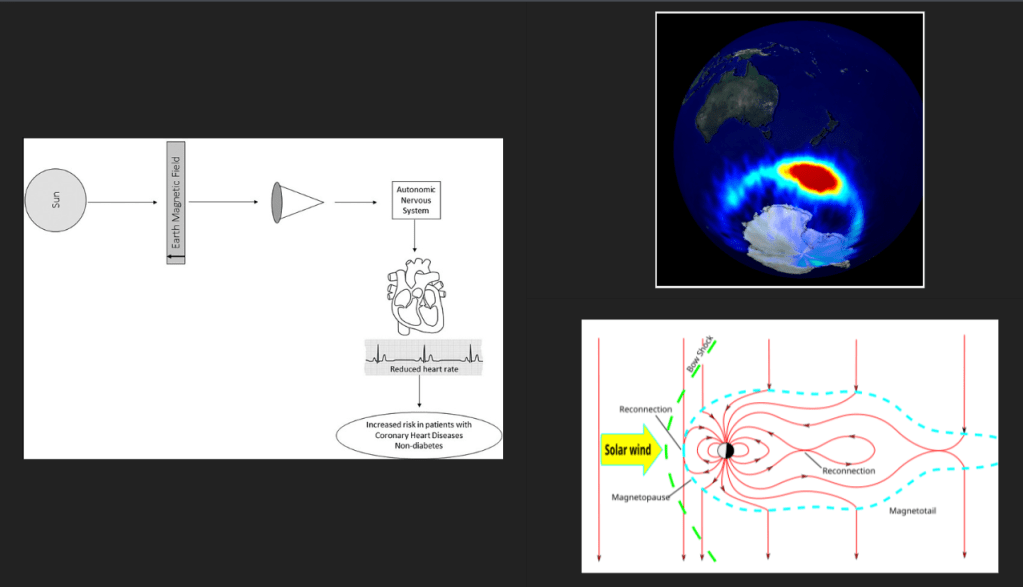
A geomagnetic storm as seen depicted in this NASA image ‘is a temporary disturbance of the Earth’s atmosphere that is driven by plasma ejections from the Sun. One type of storm is called a coronal mass ejection or CME.
During solar maxima, geomagnetic storms occur more often, with the majority driven by CMEs. When these structures reach Earth there is increased energy into the Earth’s atmosphere, increasing electric current. The intereaction between the Sun and the Earths fields are depicted here.
Electric disturbances like this can impact satellites, power grids and radio communications but also the electrical function in the heart, for up to 24 hours after an event. We see a model of the disturbance and succeeding events depicted here. The references are in the Captcha I provided.
The penetration of high-energy particles into living cells can cause chromosome damage, cancer, and other health problems.
Large doses can be immediately fatal.
“Geomagnetic Storm.” 2002. Wikimedia Foundation, Inc. November 16, 2002. https://en.wikipedia.org/wiki/Geomagnetic_storm.
Source: Zilli Vieira, Carolina L., Kelly Chen, Eric Garshick, et al. “Geomagnetic Disturbances Reduce Heart Rate Variability in the Normative Aging Study.” Science of The Total Environment 839 (September 2022): 156235. https://doi.org/10.1016/j.scitotenv.2022.156235.
Palmer, S. J., M. J. Rycroft, and M. Cermack. “Solar and Geomagnetic Activity, Extremely Low Frequency Magnetic and Electric Fields and Human Health at the Earth’s Surface.” Surveys in Geophysics 27, no. 5 (2006): 557–95. https://doi.org/10.1007/s10712-006-9010-7.
Slide 22 – Heliocentric Views
Image 1:

Image 2:

And, this is how the planets look modelled in space….the Sun and Earth are between Jup and Ura. In the heliocentric views, we see an opposition of Jupiter and Uranus (within 30 seconds) bombarding the Sun at the time of death. So, we are starting to see how this interaction between the planets and the Sun impacts the Earth. Not only is the Sun impacted, but the Earth is gathering Uranian energy as well as the Sun’s, and the Sun is energized from Jupiter and Uranus, leading to a CME.
Slide 23 – Circadian Effects of Sun on Health
Image:
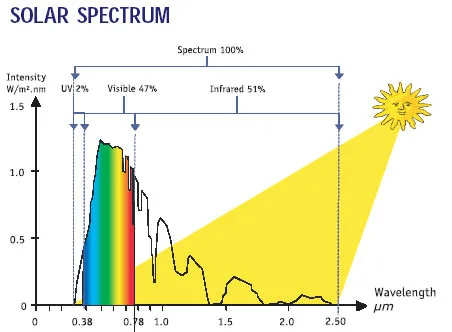
Fatal Heart attacks are more common in the winter and the night! This fact is due to lack of sunlight! Ritter did not die at night or in winter but this point is important to know.
The Sun emits the entire electromagnetic spectrum, as shown in the diagram with the most prominent forms being visible light and infrared.
Sunlight interacts directly with the human body through its ultraviolet (UV), visible, and infrared components. These wavelengths trigger distinct physiological responses
-
- Visible light is only strongly absorbed by pigments (like in the retina and blood) which are connected with the circadian rhythm (most notably through blue and red light)
- Infrared radiation is strongly absorbed by water, causing a heat sensation when the skin is exposed to sunlight
- Ultraviolet radiation does not penetrate further than the upper layers of the skin (epidermis) producing vitamin D, but also may damage proteins and DNA in the skin and eyes.
Sources:
“Radiation: The Known Health Effects of Ultraviolet Radiation.” Accessed August 27, 2025. https://www.who.int/news-room/questions-and-answers/item/radiation-the-known-health-effects-of-ultraviolet-radiation.
Scientific Committee on Emerging and Newly Identified Health Risks. “Light Sensitivity.” Europen Commisson, September 23, 2008. https://ec.europa.eu/health/ph_risk/committees/04_scenihr/docs/scenihr_o_019.pdf.
Austin, Evan, Amaris N. Geisler, Julie Nguyen, et al. “Visible Light Part I. Properties and Cutaneous Effects of Visible Light.” Journal of the American Academy of Dermatology 84, no. 5 (2021): 1219–31. https://doi.org/10.1016/j.jaad.2021.02.048.
Slide 24 – Health Effects of Circadian Rhythm
Image:
SOURCE
Image: alpine. “Chinese Medicine’s Take on Stress, Specifically Cortisol and Vitamin B6.” Alpine Integrated Medicine, May 16, 2015. https://aim4healthnw.com/chinese-medicines-take-on-stress-specifically-cortisol-and-vitamin-b6/.
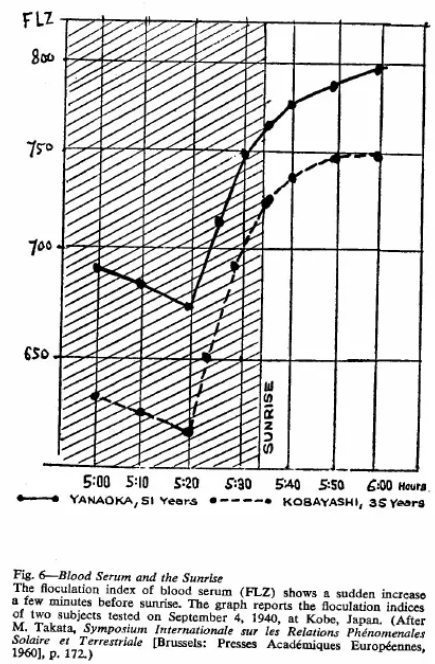
Source: Gauquelin M. The Cosmic Clocks: From Astrology to a Modern Science. Astro Computing Service. January 1, 1982. Page 100.
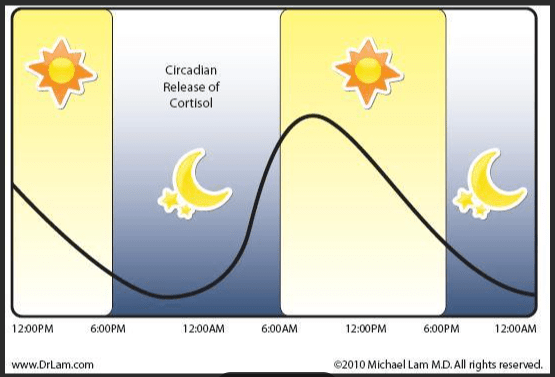
Sunlight suppresses cortisol, and darkness increases cortisol as seen in the diagram. Other stress hormones act similarly. Darkness is a basic biological stress, and sleep is protective against the stress of darkness.
Death rates for many conditions, particularly cardiovascular and respiratory issues, increase during the night and early morning hours.
December 21 is the day with the fewest hours of sunlight, but the cumulative damage of prolonged darkness reaches its peak about a month later.
The energy-producing part of cells, the mitochondrion, shows signs of being increasingly damaged as the night progresses, but they are gradually restored to their normal condition during the daytime light hours.
This means that our greatest ability to resist stress is in the late afternoon, and we are most susceptible to injury at dawn. As seen in the diagram, the clumping of RBC, probably related to stress impairing metabolism, increased markedly at dawn in this study from Gauquelin’s work.
The light which penetrates deeply into our tissues (mainly orange and red light) can improve the efficiency of energy production.
Sources:
https://www.functionalps.com/blog/2012/02/27/using-sunlight-to-sustain-life/
Jin, Qiman, Niannian Yang, Juan Dai, et al. “Association of Sleep Duration With All-Cause and Cardiovascular Mortality: A Prospective Cohort Study.” Frontiers in Public Health 10 (July 2022). https://doi.org/10.3389/fpubh.2022.880276.
A. L. Makdmov, T. B. Chernook, ” Biorhythmic aspects of intercontinental Antarctic adaptation, ” lzvestiya Akademii Nauk Kirgiskoy SSR No. 2, pp. 36 – 37, 1986.
STRESS HORMONES RISE AT NIGHT;
Hirotsu, Camila, Sergio Tufik, and Monica Levy Andersen. “Interactions between Sleep, Stress, and Metabolism: From Physiological to Pathological Conditions.” Sleep Science 8, no. 3 (2015): 143–52. https://doi.org/10.1016/j.slsci.2015.09.002.
Charloux, Anne, Claude Gronfier, Evelyne Lonsdorfer-Wolf, François Piquard, and Gabrielle Brandenberger. “Aldosterone Release during the Sleep-Wake Cycle in Humans.” American Journal of Physiology-Endocrinology and Metabolism 276, no. 1 (1999): E43–49. https://doi.org/10.1152/ajpendo.1999.276.1.E43.
SLIDE 22 – SEASONS

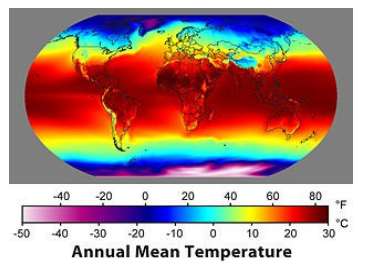
The medical literature has been slowly accumulating examples of a predisposition to specific diseases depending upon month of birth (THE season), time of day (THE circadian rhythm), and geographic latitude
In the 1980s, Seasonal Affective Disorder was recognized.
Rosenthal N, Sack D, Gillin J, et al. Seasonal affective disorder: a description of the syndrome and preliminary findings with light therapy. Arch Gen Psychiat 1984;41:72–80.
There is considerable published literature about the season of birth in schizophrenia- it has been noted that persons afflicted with schizophrenia have excess of births in the late winter and early spring
Torrey E, Miller J, Rawlings R, Yolken R. Seasonality of births in schizophrenia and bipolar disorders: a review of the literature. Schizophr Res 1997;28:1–38.
Multiple sclerosis has a greater incidence in higher latitudes, especially in the United Kingdom and Canada.
Those individuals born in the summer are epidemiologically more likely to eventually suffer from diabetes, sprue, Crohn’s disease and asthma, while those who are born in the winter have a statistical increase in dyslexia, multiple sclerosis, schizophrenia, bipolar disorder, narcolepsy, seizure disorders and autism.
Chowers Y, Odes S, Bujanover Y, Eliakim R, Bar Meir S, Avidan B. The month of birth is linked to the risk of Crohn’s disease in the Israeli population. Am J Gastroenterol 2004;99:1974–6.
Anderson H, Bailey P, Bland J. The effect of birth month on asthma, eczema, hayfever, respiratory symptoms, lung function, and hospital admissions for asthma. Int J Epidemiol 1981;10:45–51.
Dauvilliers Y, Carlander B, Molinari N, et al. Month of birth as a risk factor for narcolepsy. Sleep 2003;26:663–5.
Willer C, Dyment D, Sadovnick A, Rothwell P, Murray T, Ebers G. Timing of birth and risk of multiple sclerosis: population-based study. BMJ 2005;330:7483:120.
Those born in the winter are more likely to have diseases involving tissue derived from embryonic ectoderm destined to become nervous tissue.
Those born in the summer appear to suffer more from diseases of embryonic endoderm, destined to become gut, lung and glandular organs.
Mesoderm is the anlage of hematopoietic and lymphoid tissues, destined to become the immune system.
Davis, George E., and Walter E. Lowell. “Solar Cycles and Their Relationship to Human Disease and Adaptability.” Medical Hypotheses 67, no. 3 (2006): 447–61. https://doi.org/10.1016/j.mehy.2006.03.011.
Slide 26 – Solar Cycle Impacts on Health
The period of increased activity, known as solar maximum, is also AS WE HAVE SEEN a potentially perilous time for Earth as there are higher intensity solar winds which engage the Earth’s core as we’ve discussed and increase overall charge flow.
The current cycle, Solar Cycle 25, officially began in December 2019, according to NASA.
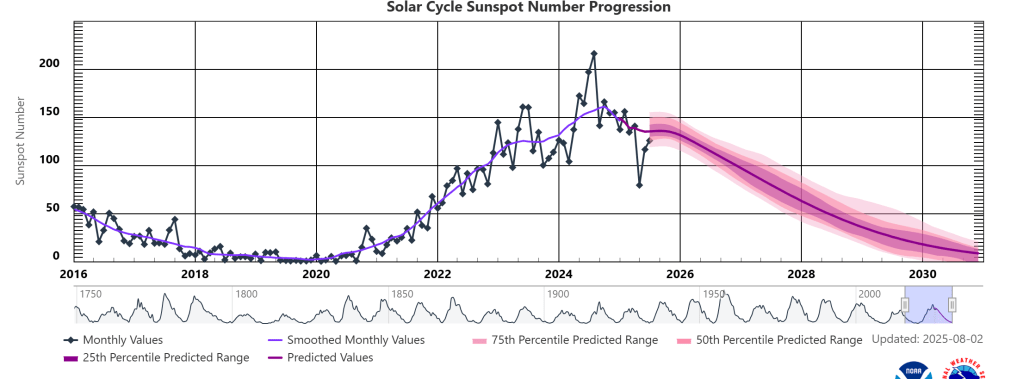
Solar cycles can impact human health by disrupting the circadian rhythm, leading to increased inflammation and affecting mood and mental health.
Increased solar activity has been linked to higher occurrences of certain autoimmune and mental health conditions, potentially due to UV radiation’s effects on DNA and immune response.
Additionally, solar cycles are associated with fluctuations in vitamin D deficiency, which can influence susceptibility to infectious diseases.
SLIDE 27 – Study
This is an interesting study of the impact of the 11-year solar cycle peaks on human predisposition to disease
Birth data and diagnosis were obtained from Maine Medicaid database from 1995 to 2004 for 236,962 unique people. There were 4 disease categories: (1) mental, (2) metabolic, (3) autoimmune, and (4) neoplastic. Solar cycle data for sunspots also obtained – note made of exceedingly high sun spot numbers.

Mental illnesses is most affected by excessive sun spots, followed by the autoimmune diseases. 11-year solar cycle peaks predispose humans to disease, probably by UVR mutation of the genome. It is also clear that UVR is not always harmful; indeed, the neoplasms examined in this study were suppressed by cycle peaks. Other diseases, like multiple sclerosis, may also be ameliorated by UVR, suggesting that solar radiation can be a modulator of disease. Mutations by UVR, if not completely repaired, must eventually be managed by organisms epigenetically.
Davis, George E., and Walter E. Lowell. “Solar Cycles and Their Relationship to Human Disease and Adaptability.” Medical Hypotheses 67, no. 3 (2006): 447–61. https://doi.org/10.1016/j.mehy.2006.03.011.
Slide 28 – Ongoing Independent Research
My research in these areas is
Slide 29 – Conclusion